How do you make a good decision?
With over 30,000 decisions that we make every day, it’s unrealistic and exhausting to approach each of them with a process. Most decisions are made instinctively, driven by our autonomic nervous system and learned behaviors. And that’s perfectly fine.
But what about the few important decisions – the ones that shape your habits, relationships, and future? Let’s say there are five such “strategic decisions” you make today. The real question becomes:
How do I make a decision I won’t regret later?
Or better yet…
How do I make a decision I’m okay regretting later? After all, as the wisdom goes – choose your regrets!
As a practitioner of mindful productivity, I’ve found the Wise Mind technique, borrowed from Dialectical Behavior Therapy (DBT), to be an elegant and effective approach to make… well wise decisions.
“All people have within themselves the ability to be wise.” – Dr. Marsha Linehan (founder of DBT practice)
Here’s how it works. We all operate within three states of mind…
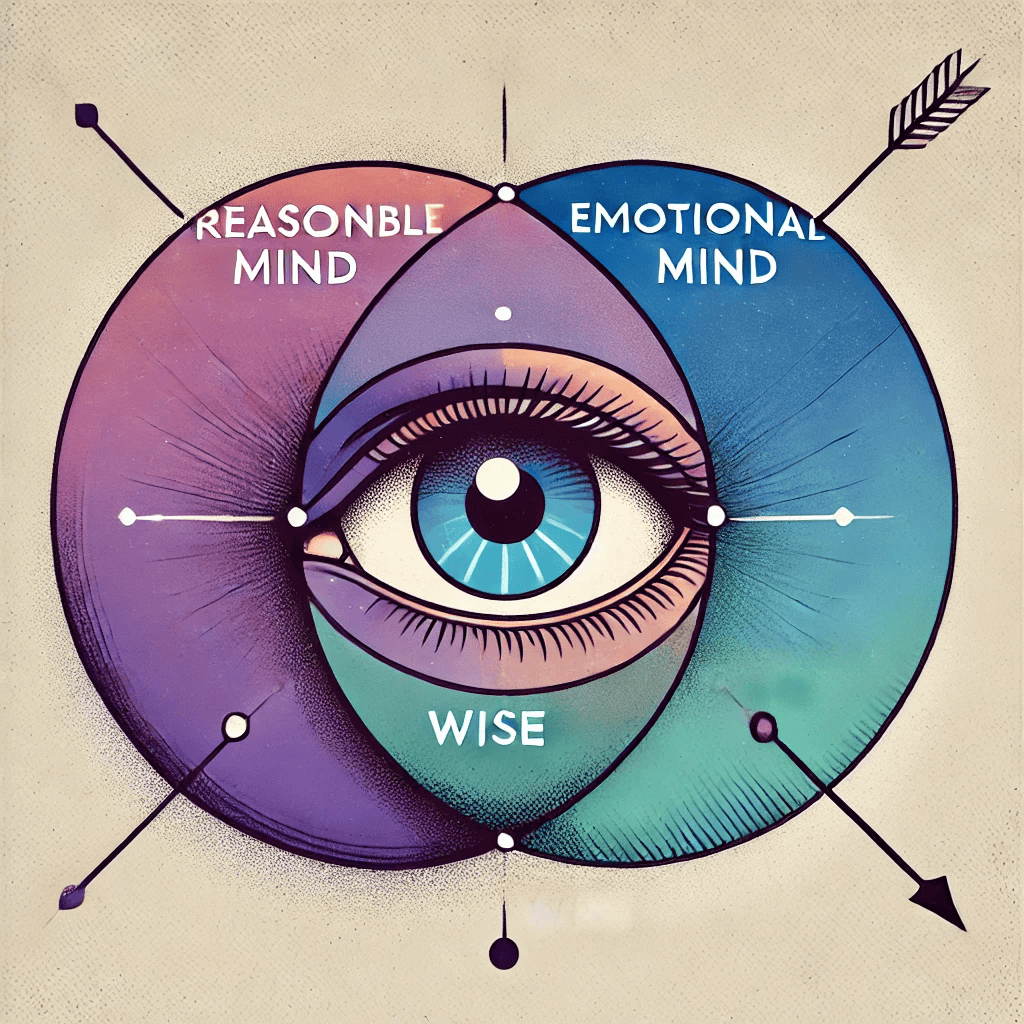
Reasonable Mind
- When you are ruled by facts, reason, logic, and pragmatics.
- Values and feelings are not important.
- Behavior is cool, calculated, and unemotional.
Emotional Mind
- When you are ruled by your moods, feelings, and urges to do or say things.
- Facts and logic are not important.
- Behavior is fueled by the intensity of emotions.
Wise Mind
- It is a synthesis of both emotional and reasonable minds.
- Values both logic and feelings, bringing the left and right brains together.
- Behavior often results in an “aha” moment; a clear sense of the right course of action.
Wise Mind is where thoughtful decisions are made; decisions you can stand by, regardless of the outcome. It’s not about compromise; it’s about integrating reason and emotion to see the bigger picture. It’s about radical acceptance of reality, even in the face of fear and doubt.
Wise Mind is personal. It varies from person to person and from situation to situation. But its clarity can guide you through any type of decision.
Found this helpful?
If this article resonated with you, please share it on LinkedIn to help me spread the word on Mindful Productivity.
🍪 Fortune Cookie:
Wise decisions come with practice, and practice starts small. Begin by applying the Wise Mind approach to just one decision today. Over time, with consistent practice, this clarity will naturally guide more of your choices – automatically.
Here’s an example of how I recently applied the Wise Mind technique to a decision I needed to make:
What did I want to decide?
Since I already publish on LinkedIn and on my website, adding Medium as a third platform required thoughtful consideration.
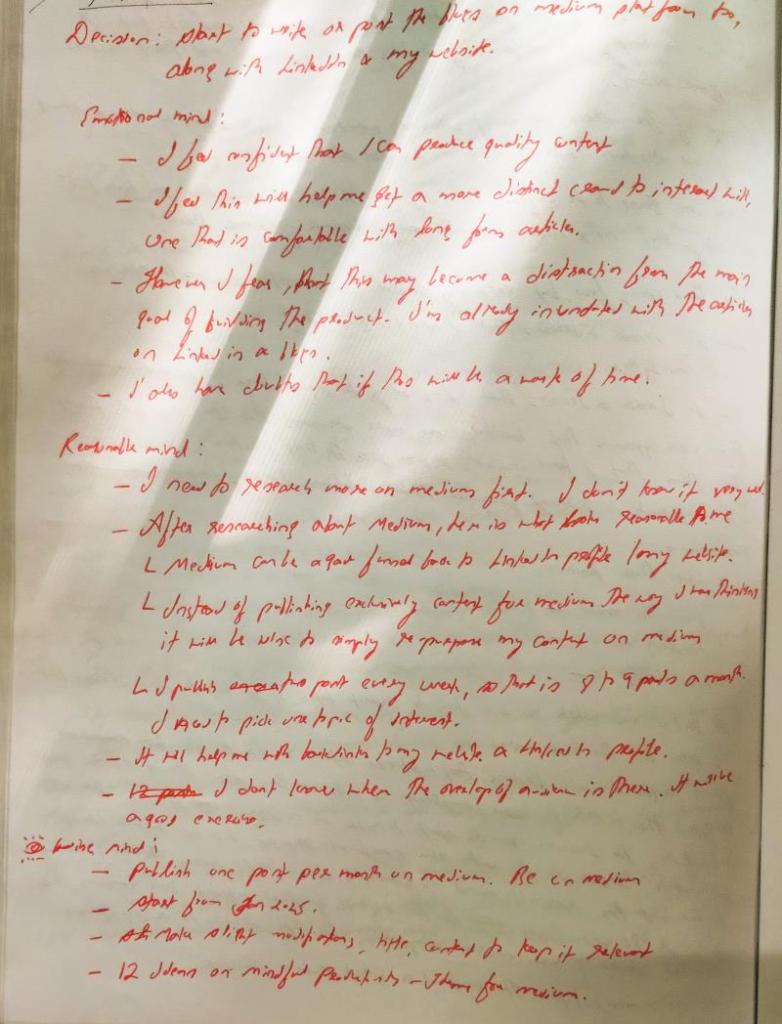
I prefer using pen and paper to map out what my emotional, reasonable, and wise mind tell me. However, feel free to simply think aloud or use any method that works for you.
What is my emotional mind feeling?
My emotional mind gets the first say, allowing it to be fully heard before logic steps in. This approach ensures that my reasonable mind can take over without resistance. For you, it might work the other way around.
Here’s what my emotional mind expressed:
- Confidence that I can create high-quality, exclusive content expected on Medium, where readers pay for valuable insights.
- Excitement about finding an audience for my long form content.
- Fear that Medium may be a distraction from building my product.
- Overwhelm at the thought of managing content across three platforms.
- Doubts if Medium will truly help me find early adopters.
Related articles:
The practice of recognizing (or sensing) your emotions.
Expand your emotional vocabulary to fine-tune your brain’s responses.
What is my reasonable mind telling me?
Once my emotions are acknowledged, I shift my focus to logic and facts.
Here’s what my reasonable mind concluded:
- I need to research Medium further as I don’t know enough about the platform.
- Using ChatGPT, I validated questions about Medium’s audience, features, and potential.
- Medium can serve as a platform for backlinks and early SEO.
- I can repurpose my articles instead of writing new ones.
- A consistent theme, like “12 Ideas on Mindful Productivity for 2025,” could help establish a following.
What does my wise mind want me to do?
After listening to both my emotional and reasonable minds, here’s what my wise mind suggested:
- Experiment with Medium without over-investing time or effort.
- Repurpose one article out of every 8 to 9 published monthly on other platforms.
- Limit publishing to one article per month.
- Build a theme – 12 ideas on Mindful Productivity for 2025.
- Use the platform to test whether backlinks effectively drive traffic.
This approach feels balanced, allowing me to explore Medium without becoming overwhelmed. It synthesizes the excitement and concerns of my emotional mind with the practicality of my reasonable mind.
A Note on Flexibility:
Wise decisions don’t always require balance. Sometimes, your emotional mind takes precedence (as it did when I decided to start up again despite my reasonable mind urging me to find a job). Other times, logic outweighs emotion (as it does when I continue renting a house despite being emotionally attached to owning one).
In the end, publishing on Medium may or may not turn out to be the “right” decision. But it feels like a wise decision for me – a thoughtful synthesis of my emotional and reasonable minds, balanced and intentional.
So, what decision are you stuck with today? Take a moment to pause, listen to your emotional and reasonable minds, and let your wise mind guide the way.

