“All of humanity’s problems stem from man’s inability to sit quietly in a room alone”. – Blaise Pascal
For many, aloneness isn’t the problem. In fact, we crave and enjoy it. What unsettles us is introspection – the subjective assessment of our objective reality in solitude.
Introspection is like a mental Pinball game, bouncing between hypothetical worries and imagined outcomes. Blaise Pascal’s observation about “man’s inability” wasn’t about solitude itself but about our struggle to sit in self-awareness and reflect on our experiences meaningfully.
The fourth step in the Mindful Productivity Framework – Ponder – is about this self-awareness. The slow, deliberate, and deeper reflection of our emotions rather than evaluation of cold facts.
The first three steps are Sense, Trace, and Orchestrate.
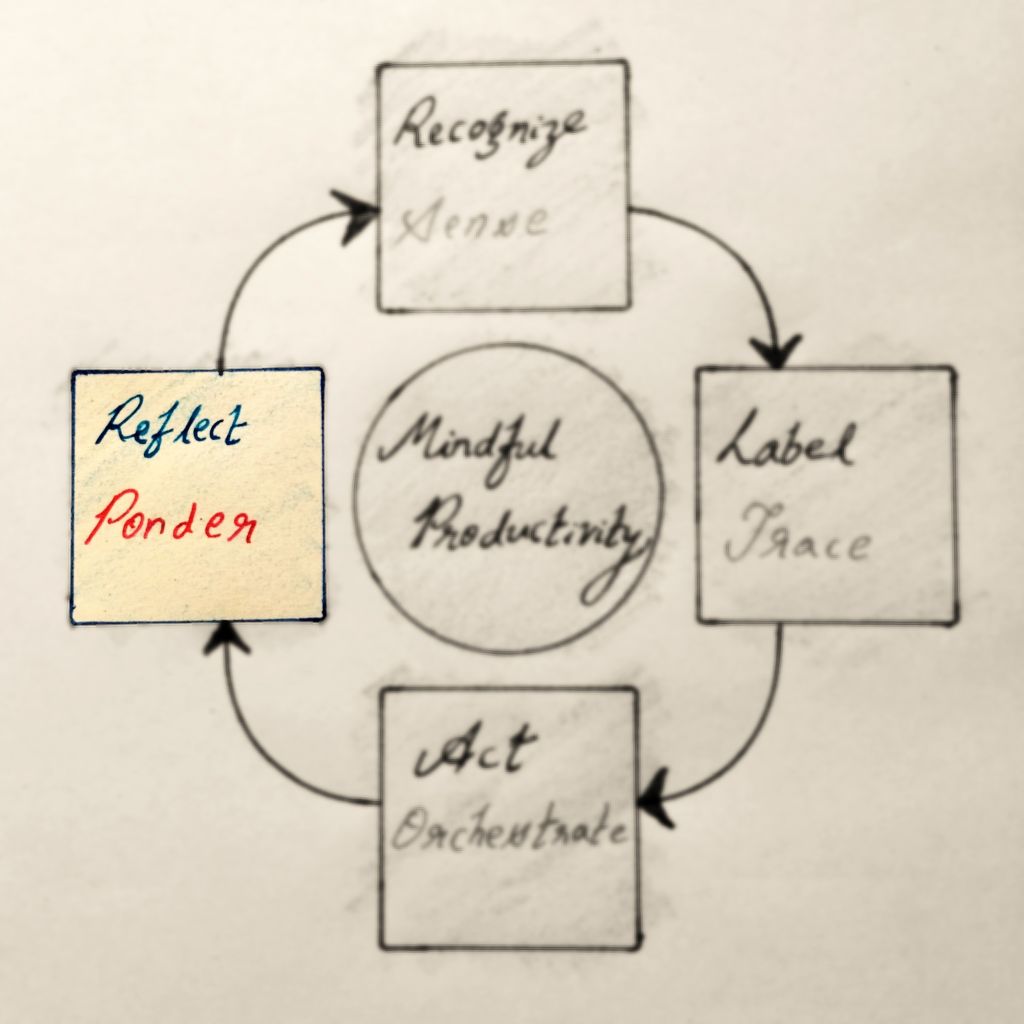
Pondering is a transformative skill rooted in the practice of presence. It is keeping your senses open and listening to what your body is telling you after an experience. Here’s why it matters:
Connecting outcomes with goals
Emotions change with time. This subtle reality prevents us from distinguishing meaningful pursuits from distractions.
In decision-making, understanding why you started is just as important as reaching the destination. Pondering helps connect these dots by allowing you to recognize how your emotions have shifted from before the decision to after acting on it.
As Chris Williamson of the Modern Wisdom podcast insightfully points out,
“Ultimately, you are doing things not to say you’ve done them, but for the experience of having done them”.
By optimizing for how you feel about the experience, you detach from chasing outcomes and, paradoxically, improve the very outcomes themselves.
Courage to change behavior
Good decision-making requires a balance between perseverance and letting go, acceptance and change. Reflection is the means of identifying that balance.
One of my friends practicing Mindful Productivity shared this insight,
“I used to dread calls with a specific colleague, feeling anxious and avoiding their call every time. But after two sessions of mindful reflection, I realized I genuinely enjoyed speaking with them. I just hadn’t paused to reflect, so I carried my initial biases into every call I used to have with them”.
As Ray Dalio writes in Principles:
“If you can think for yourself while being open-minded in a clearheaded way to find out what is best for you to do, and if you can summon up the courage to do it, you will make the most of your life. If you can’t do that, you should reflect on why that is – because that’s most likely your greatest impediment to getting more of what you want out of life”.
Turning confusion into clarity
Confusion often stems from our inability to distinguish facts from opinions. Silent observation of our emotions without judgment or condemnation is the clearest way to uncover the truth of our experiences.
If we can look at the fact as is, without any additive qualities of the mind, then there is no confusion.
As JD Krishnamurthy writes in What Are You Doing With Your Life?,
“To acknowledge to oneself that one is confused requires, not courage, but a certain clarity of thought, clarity of perception… When [a] confused mind acts, it can only produce further confusion; but a mind that is aware that it is confused and understands this whole process of confusion need not act because that very clarity is its own action“.
In other words, sometimes the wisest decision is to pause and do nothing until clarity emerges.
🍪 Fortune Cookie:
So how can one practice pondering?
The beauty of pondering lies in its simplicity – it’s about revisiting the first step (Sense), but now focusing on how you feel after acting on your decision.
Let me share this process with an example.
Decision:
Writing this article – the fourth step of Mindful Productivity Framework which I have been delaying for some time now.
Let me walk through each of the four steps to highlight how Pondering is a useful agent.
Step 1 – Sense:
I took some time to sense the feelings that’s keeping me from writing this post. These were the feelings,
- I was neutral, neither feeling pleasant or unpleasant on not starting!
- Even my energy levels were neutral, neither agitated nor calm
Step 2 – Trace:
I acknowledged these emotions by writing them down.
- There is shame: I feared anticipated failure.
- There is paralysis: I felt emotionally overwhelmed.
- There is helplessness: I had no idea how to start.
Step 3 – Orchestrate:
After tracing my emotions, I felt light and could feel the energy flowing in me. I began typing directly instead of writing which I normally do, and within two hours, I had a complete draft of the article!
I am always amazed at the openness that unfolds by just sensing and tracing my emotions.
Step 4 – Ponder:
Now that I’ve nearly completed the article, here is my reflection on how I feel:
- There is satisfaction – relief on having done it
- There is pride – happy with the result
- There is enthusiasm – for the next steps I am free to take
Unlike here, pondering isn’t always about moving from “bad” to “good” feelings – it’s about observing emotions honestly as they arise. Some activities may leave you feeling worse after completing them. That feedback is invaluable, signaling decisions you might want to avoid making in the future.
Remember to stop!
The Mindful Productivity Framework is easy to remember. It is STOP: Sense -> Trace -> Orchestrate -> Ponder.
It is a reminder to pause before and after decisions – creating space for meaningful, intentional choices rather than being caught in the busyness that gets us nowhere.
“You can’t think yourself into new ways of acting; you can only act yourself into new ways of thinking”. – Marsha Linehan
 Nikhil Kabadi