“What we do in life echoes in eternity.” – Gladiator (2000)
Piltdown and Taung both claimed to be our ancestors. Their story affords a fascinating insight into:
- The missing link when apes evolved to become us,
- Confirmation bias and why we always look to answer easy questions,
- Why foundations built on short-cuts eventually crumble when their echoes reverberate.
But first, let’s meet Piltdown and Taung…
One gave people what they wanted to believe. The other forced them to update their beliefs.
Piltdown Man
Piltdown was presented as a man who lived ~750,000-years ago. His fossil was unearthed in Sussex, UK, in 1912 by an amateur British archaeologist, Charles Dawson.
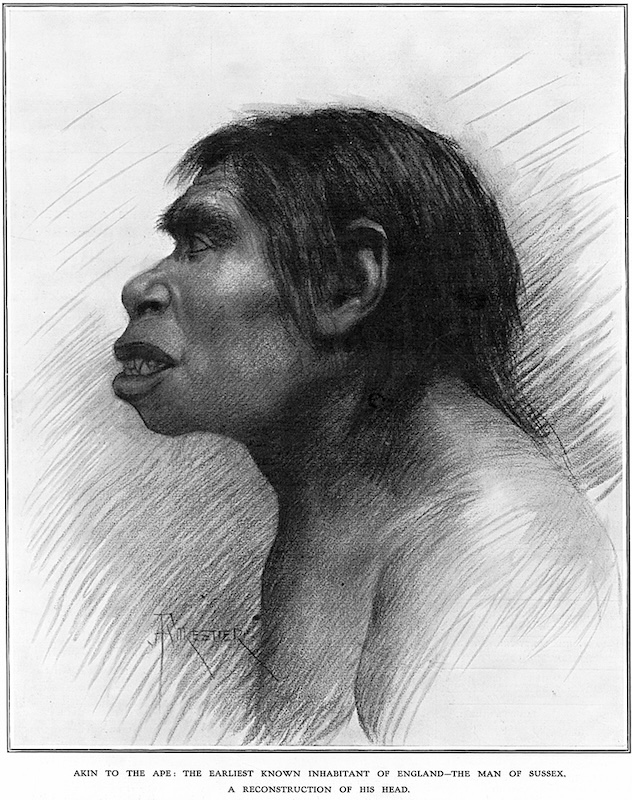
Dawson’s find is announced in the Illustrated London News, December 28, 1912.
Piltdown fossil was a revolutionary find. His discovery meant:
- The missing link between the transition of non-human primates to homo-sapiens was now decisively solved,
- It confirmed the prevailing “brain-first” model: we transitioned to homo-sapiens by developing a larger brain first, before losing our ape-like features (large jaws, etc),
- And more importantly, it strengthened the cultural disbelief of a nonsensical African origin theory for humanity. The Piltdown discovery reinforced the prevailing idea that modern humans originated in Europe (maybe, even England).
With this discovery, Charles Dawson became the Wizard of Sussex, a reputed solicitor who was also now a groundbreaking archaeologist and a Gentleman Scientist, the man who solved the mystery of man.
Taung Child
Taung was a ~4-year-old child who likely died when a prehistoric Eagle made him its meal 2.8 million years ago.
Taung’s fossil was discovered by Raymond Dart, an Australian anatomist and anthropologist, in South Africa in 1924 (12 years after the Piltdown Man).
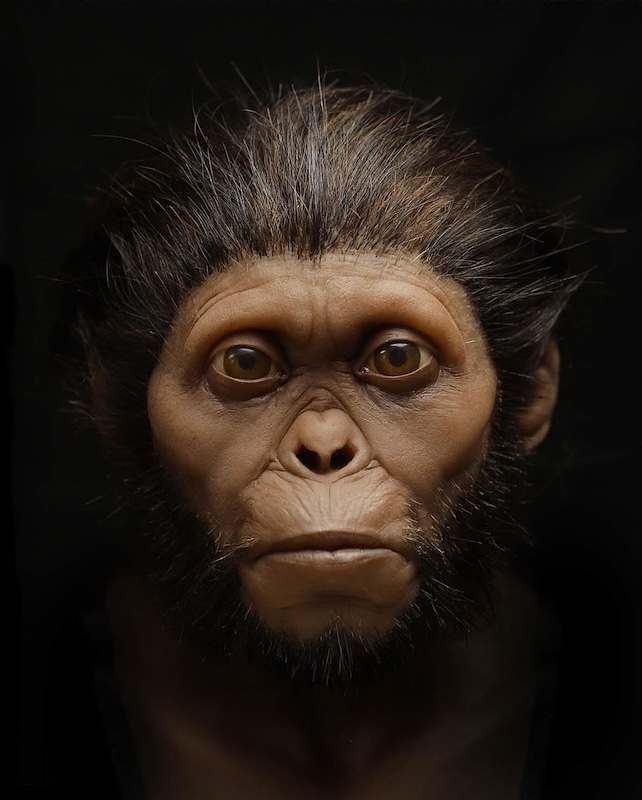
Pigmented silicone cast of facial reconstruction of Taung child.
Whereas Dawson’s Piltdown fragments came from a gravel deposit and were easily found in pieces, it took Dart several years of meticulous patience to separate the bone fragments from the lime quarry to reveal Taung’s skull.
Taung Child contradicted everything that Piltdown Man established. Specifically,
- Our brains remained small for a long time, while our faces were already transitioning to modern human-like features.
- It corroborated what Charles Darwin (origin of species fame) had already predicted: that modern humans originated in Africa.
When Dart asserted that our ancestor was actually a small-brained, bipedal, ape-like creature from Southern Africa, it was almost immediately dismissed as preposterous scientific nonsense.
For decades, Dart was isolated and shunned by the scientific community as a discredited scientist.
What follows is a fascinating insight into the “biggest scientific hoax of the century” on one end, and the resilience of one man against the confirmation bias of a population on the other end.
A Perfect Lie
The 19th century was a desperate search to answer the anthropological question: What specific “missing link” represents the transitional species between non-human primates and the ancestors of modern humans?
But for Charles Dawson and the scientific establishment supporting him, this seemingly impossible question was replaced with an easier one: How do we find evidence that links modern man to a European origin and that a large human-like brain evolved before a modern human body?
Dawson had the perfect answer – he forged a fossil to answer exactly that question. With painstaking effort:
- He collected fragmented pieces of a modern human skull,
- Then, he took the teeth and jaw of an Orangutan,
- Filed the teeth to match the primat-ish look of prehistoric man,
- Chemically dyed the bones to make them appear a geographically consistent find.
- Called it a human fossil!
That forged fossil became the Piltdown Man, a hoax that persisted for decades and misdirected the trajectory of human evolutionary studies.
This hoax persisted not because the forgery was perfect. It was far from perfect. There were tell-tale signs that something was wrong. For example:
- The jaws did not fit neatly with the skull.
- Dawson always found the “missing” bone fragments, almost magically, when doubts were raised.
- Finding prehistoric human fossils just below a gravel heap itself was dubious.
The hoax persisted because it answered the question that confirmed the collective belief everyone wanted to hear: that humans originated in Europe and were never related to apes.
Our lineage branched from an intelligent species, that of Piltdown and his brood.
Every time a doubt was raised, there was a scientist who had an answer ready to support Dawson’s finding.
Aged 52, Dawson died ceremoniously as one of the century’s most prominent figures. This hoax was never revealed in his lifetime.
Dawson even had decades of posthumous fame. But many young anthropologists doubted the Piltdown Man and never stopped studying it. With technology evolving, the mask eventually fell in 1953.
When the forgery was exposed, his name became a cautionary tale of chasing recognition and fame at the cost of personal integrity and scientific truth.
An Inconvenient Truth
The Taung Child (Australopithecus africanus) checked off every piece of empirical data on a fossil finding,
- It had the marks of a real fossil discovery,
- As with any significant scientific truth, it was a painstaking, slow process of separating the bones from the lime.
- Unlike Dawson, who was a novice in archaeology, Dart was a seasoned anthropologist who had spent years studying and teaching human anatomy.
But there was one thing that didn’t check off for Taung, and, unfortunately for Dart, it contradicted what people wanted to believe.
Dart was not just shunned from the scientific community; he also received threats from members of various religious communities who proclaimed his ideas blasphemous. Darwin had already ruffled a lot of feathers; the last straw would have been a conclusive proof, which the Taung child provided – a direct challenge to the traditional theological accounts of human origins.
A Legacy Etched In History
Dart was finally vindicated in 1953 when the Piltdown Man was conclusively established as a work of forgery.
Over all those decades, Raymond Dart kept up with his studies, amassing evidence for the theory of human evolution, linking it to Africa.
When, in 1973, he finally delivered his lecture, The Discovery of Australopithecus and Its Implications, he was 80 years old.
Today, his name echoes of resilience, patience, and one man against the world. Not only is his discovery ranked alongside Darwin’s Origin of Species in importance, but he is also the man who established the cradle of humankind.
The Taung Child is now considered as the cornerstone of human evolution. The missing link between apes evolving as humans.
Liked the article?
If it sparked a thought or made you pause, consider sharing it on LinkedIn – it might do the same for someone else.
Related article:
 Nikhil Kabadi