Before you name “anger”, you experience “agitation”.
Before you name “guilt”, you experience “discomfort”.
Before you name emotions, you experience feelings.
This isn’t just wordplay – it’s neuroscience in action.
Our brain generates feelings (affect) by interpreting body signals through an ongoing process called interoception.
For example, body signals like a racing heart, a tight stomach, or jittery hands don’t immediately mean anxiety or excitement. It’s only when the brain interprets these signals based on context (our environment and social reality) and past experience that we say, I’m nervous or I’m thrilled.
Without first sensing our raw feelings, we risk mislabeling our emotions, which leads to poor decisions. Someone who assumes they’re angry may actually be overwhelmed, needing rest rather than confrontation.
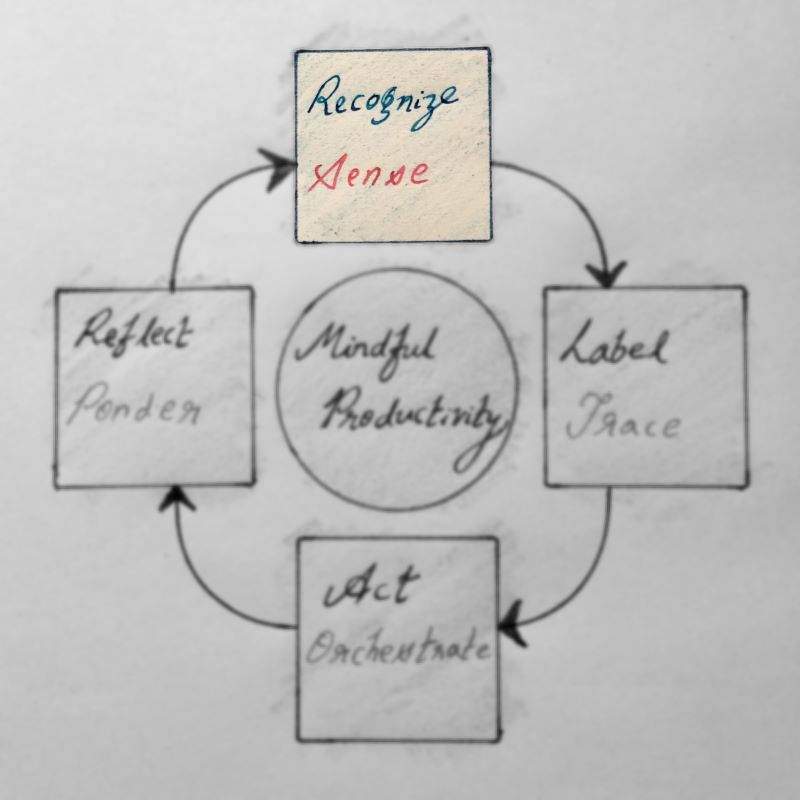
We are creatures driven by feelings. And feelings exist to help us make good decisions. This is why the first step in the STOP Mindful Productivity Framework is to sense feelings first – before assigning emotion labels.
Understanding Affect
Unlike emotions, which are subjective interpretations, feelings are universal because they arise from two core dimensions:
- Valence – The degree to which a feeling is pleasant, neutral, or unpleasant.
- Arousal – The intensity level of that feeling, ranging from calm to activated.
Valence and arousal are constantly fluctuating as your brain and body interpret internal states in real-time, even when you’re not consciously aware of it.
How to Sense Feelings the Right Way
The STOP framework is unique because it aligns with affective neuroscience. The first step, “Sense”, blends mindfulness with a deep understanding of how the brain makes feelings.
Instead of immediately labeling an emotion, STOP helps you slow down and map your feelings based on interoception.
By consistently practicing this, you can deconstruct the raw sensations fueling your experience:
- Anxiety may just be a fast heartbeat and heightened alertness.
- Happiness may feel like a surge of warmth and lightness.
- Sadness may register as a sinking sensation in the chest.
This matters because your body state affects your decisions. Recognizing and adjusting it gives you greater control over your actions.
Found this helpful?
If this article resonated with you, please share it on LinkedIn to help me spread the word on Mindful Productivity.
🍪 Fortune Cookie:
“Fish swim, birds fly, and people feel.” – Haim Ginott
The following is a simple 5-minute exercise to sense feelings.
With practice, this takes only about 2 minutes and can be done anywhere – standing, sitting, walking, or even lying down.
- Begin by observing your natural breathing rhythm. Don’t try to change it.
- Ensure you’re breathing through your nose, not your mouth.
- Gradually focus on each inhale and exhale.
- Narrow your attention to the sensation of air at the tip of your nose as you breathe.
- If it helps, gently place a finger on the tip of your nose to feel the sensation, then remove your finger and continue observing.
- Slowly begin to extend the duration of each inhale and exhale. Breathe longer and slower rather than short and shallow.
- Notice any rigidity in your body (like clenched fists or tight jaws). Use this moment to relax.
- Once relaxed and connected to your breath, allow yourself to sense the feelings that surface.
- “Am I feeling pleasant, unpleasant, or neutral?” (Valence)
- “Am I feeling calm, energized/agitated, or neutral?” (Arousal)
- As feelings emerge, simply note them. Say to yourself: “I’m feeling pleasant and calm” or “I’m feeling neutral”.
- Continue observing your breath, and see if these feelings shift or stay the same.
- Once you’ve recognized your predominant feelings, you are ready for Step 2: Trace – Labeling the Emotion.
No decision is ever free of affect.
Your body is always feeding raw data to your brain. Whether you ignore it or use it wisely determines how effective your decisions will be.
Sensing your feelings is the first act of self-awareness – and self-awareness is the foundation of informed and intentional decision-making.
 Nikhil Kabadi