Emotions don’t simply happen to us; they are constructed.
Before you feel “fear”, your body first registers unease or high arousal.
Before you feel “joy”, your body first experiences lightness or warmth.
Before you name an emotion, you feel something first.
But emotions like “fear” don’t just pop up because your amygdala detects danger!
The theory of constructed emotion suggests that your brain doesn’t passively receive information and then react with emotion (eg: see boss walking towards your desk -> feel fear). Instead, it predicts emotions based on past experiences, bodily sensations, and learned concepts. In other words, what “boss” and “fear” mean to you personally determines how you feel and what emotion concept you use.
This is why the distinction between feelings and emotions is very important.
In Mindful Productivity, emotions are not obstacles but signals that influence behavior and decision-making. By understanding how emotions are constructed, we gain control over how they shape our actions.
This is why in STOP:
- Sense: We first recognize raw bodily sensations (affect) before assigning meaning.
- Trace: We then label emotions to ensure we interpret them accurately for better decision-making.
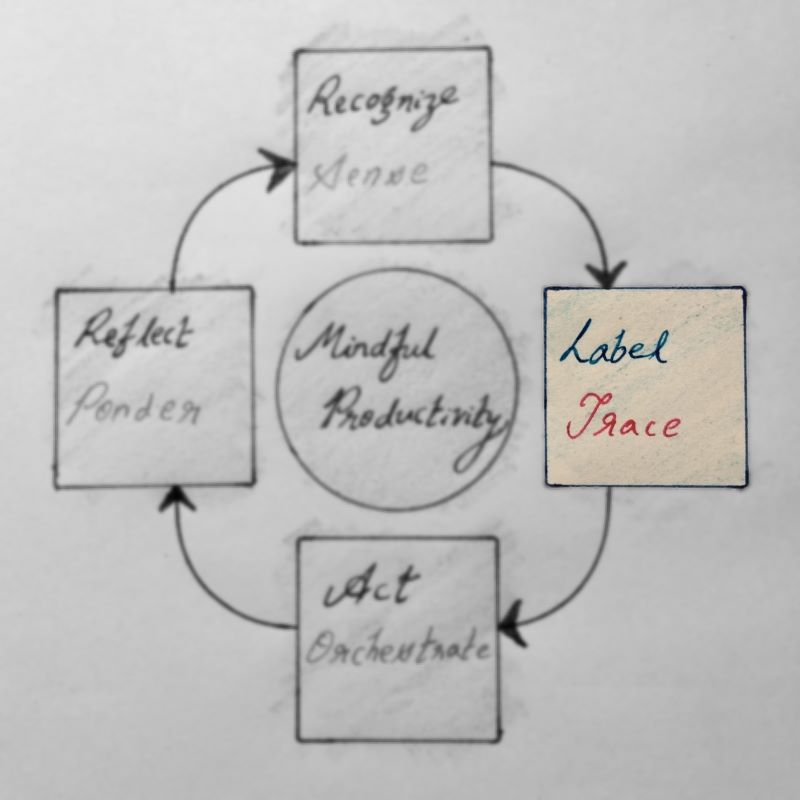
How Labeling Emotions Changes Your Perspective
“Language is a powerful tool for influencing human behavior.”
Tracing emotions is self-observation, and self-observation is fundamentally different from self-absorption.
- Self-absorption means being consumed by emotions leading to overthinking, impulsivity, or reactivity.
- Self-observation means stepping back and watching your emotions as though they belong to someone else. This creates space between you and what you’re feeling, allowing for unbiased decision-making.
Here’s a simple comparison:
Self-Absorption (Emotion-overload)
“I’m anxious and angry.”
Highly personalized, often leading to impulsive actions like “This meeting is a waste of time. Damn it!”
Self-Observation (Emotion Awareness)
“There is anxiousness. There is anger.”
Detached recognition, allowing mindful action: “Okay, I need to prepare for this meeting to contribute effectively” or “I must politely decline because my time is better spent elsewhere.”
Labeling helps you observe emotions without judgment. It’s the first step to understanding yourself. Without understanding, there’s no way to fix your productivity, or your life.
“Clouds come and go: some of them are black and some white, some of them are large, others small. If we want to follow the analogy, you would be the sky, observing the clouds [emotions].” – Anthony De Mello
Why Labeling Emotions Improves Decision-Making
The practice of labeling emotions, also called affect labeling, is a fascinating area of psychological research. While studies are still uncovering its full potential, here’s why it works:
Emotions encode valuable information
- Fear signals a potential threat -> prompts caution.
- Anger signals a boundary violation -> prompts assertive action.
- Sadness signals loss or change -> prompts reflection and recalibration.
- Joy signals positive reinforcement -> prompts engagement in rewarding behavior.
“Mislabeled emotions can lead to misaligned actions. The right label helps trigger the right response.”
Accurate emotion labeling enhances cognitive processing
- Naming emotions improves interoception – the brain’s ability to make sense of bodily signals.
- This engages the prefrontal cortex, refining your brain’s predictions and enabling more deliberate decision-making.
- For example: If you label “There is frustration” instead of “I’m angry“, you might recognize that frustration is coming from a lack of clarity, allowing you to ask better questions rather than lash out.
Labeling improves emotional precision
- If a person feels drained but mislabels it as laziness, they may push themselves unnecessarily rather than recognizing the need for rest
- Precise labeling prevents emotional distortion, helping you act appropriately.
Trace helps regulate emotions without suppressing them
- People often suppress emotions because they don’t have the right words to describe them.
- The Trace step allows emotions to be acknowledged and processed rather than dismissed or acted on impulsively.
Found this helpful?
If this article resonated with you, please share it on LinkedIn to help me spread the word on Mindful Productivity.
🍪 Fortune Cookie:
Do you always feel “angry”? Or is it sometimes “outrage”, other times “fury”, and on most days just “annoyance”?
The ability to distinguish and precisely label emotions is called emotional spectrum. The more precisely you label emotions, the better your brain fine-tunes its responses – directly shaping your decisions and actions.
If you find yourself using the same few words to describe emotions, it’s time to expand your emotional vocabulary.
Explore this curated list of nuanced emotion words and discover how naming emotions can transform your well-being and decision-making.
Related topic:
 Nikhil Kabadi