Losing Mind Is A Paradox
When we lose our mind…
…Should we try and find it?
Losing one’s mind is a paradox. It doesn’t happen because we forgot to use it or misplaced it somewhere.
We lose our mind because we overuse it – through overthinking, rumination, or getting caught in relentless emotional impulses.
And what makes it even more fascinating is we can still use a lost mind!
Of course, we all know what happens when we try to use a lost mind. There is more confusion, more misjudgment, and even more mental exhaustion.
Buddha offered a simple yet profound solution to this conundrum:
“Bikkhus, abandon what does not belong to you”.
A lost mind no longer belongs to you. It no longer serves you.
The answer is not to search for the same mind but to discover a new one – new thoughts, new perceptions, new clarity.
You’ll be surprised by the other minds that exist within you, waiting to emerge.
STOP is exactly that skill. An approach to discovering new thinking and building fresh perspectives.
It’s a simple, practical, and immediate mindful productivity framework, designed precisely for these lost-and-found moments in life.
How To Believe In An Answer?
Have you ever noticed that if you ask someone a question, they almost always give you an answer?
Recently, an entrepreneur who is also a podcaster and author, reached out to me with this intriguing question:
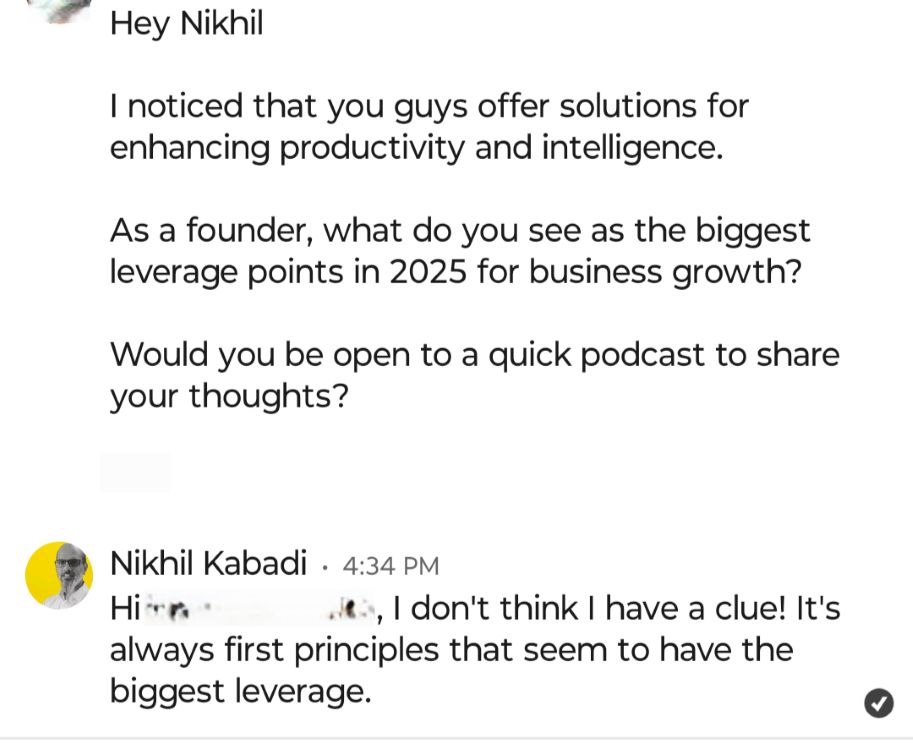
“Hey Nikhil, I noticed that you guys offer solutions for enhancing productivity and intelligence.
As a founder, what do you see as the biggest leverage points in 2025 for business growth?
Would you be open to a quick podcast to share your thoughts?”
Feeling entirely uninformed, I shared what I genuinely believe is the greatest leverage for growth:
“Hi, I don’t think I have a clue! It’s always first principles that seem to have the biggest leverage”.
Needless to say, I didn’t receive that podcast invitation.
But curiosity got the better of me. So, I posed the same question to DeepSeek, Gemini, and ChatGPT, and here’s what they suggested:
DeepSeek recommended:
- AI & Automation at Scale
- Data & Predictive Analytics
- Sustainability as a Profit Driver
- The Rise of the “Phygital” Experience
- Direct-to-Consumer (DTC) & Community-Led Growth
- Emerging Market Expansion & Localization
- Agile & Remote Workforce Optimization
- Regulatory & Compliance Arbitrage
Gemini highlighted:
- Data-Driven Strategies
- Artificial Intelligence (AI) Integration
- Intellectual Property (IP) Strategy
- Focusing on the “Wins” and Adapting
While ChatGPT suggested growth hinges on:
- Advanced Technologies & Automation (AI, Machine Learning, IoT, 5G/6G)
- Digital Transformation & Data-Driven Strategies
- Sustainability & ESG Initiatives
- Evolving Work Models & Talent Strategies
- Cybersecurity & Digital Trust
- Global Market Expansion & E-Commerce Innovation
Surprisingly, or perhaps unsurprisingly, first principles didn’t make the cut.
We live in an era where getting answers has become too easy. Answers have become commodities. But not every answer that’s believable is genuinely actionable.
Complexity often overshadows common sense.
So how do we trust answers, especially generated by AI? Use Mindful Productivity to validate the responses by:
- Asking yourself – “Is it true for me?” A meaningful diagnosis requires depth, patience, and self-awareness.
- Seek contradictory views. For a generated answer, pose this question explicitly – “What are some contradictory opinions about [topic]?”
- Revisit step 1 with these contradictions. Evaluate again what the response means to you.
And how do you believe when an answer comes from a fellow human?
Ray Dalio’s advice remains timeless:
“If you ask someone a question, they will probably give you an answer, so think through to whom you should address your questions!” – Ray Dalio
Liked the article?
If it sparked a thought or made you pause, consider sharing it on LinkedIn – it might do the same for someone else.
Related topics:
 Nikhil Kabadi