Decision-making is a catch-22. We are mostly confident we are good at it, but carry our doubts nonetheless. A decision can feel very different when made from a calm, clear mind versus a loaded, struggling mind.
When I decided to start Eibira to help people make better decisions, I did not intend to dole out solutions to every problem. But to offer different paths for thinking, drawing on the science of psychology, evolutionary biology, and mindfulness practice.
And the need to dive into the science of decision-making was a personal endeavour, a journey I had to take to understand what was happening in my own life.
Lived Experience
My first aha moment for Eibira was in 2019. Though it was not in any way the shape it is today, the problem statement remained the same: how to help people make better decisions in life.
I was confident that the challenges I had faced up to that point in my life were not only unique but also unfair. I had a failed start-up, saw my bank balance drop to zero, and was struggling to find my footing on the corporate ladder.
But I had survived and rebuilt my life. This, I believed, gave me a vantage point to build a product on how to navigate life when faced with “unfair” challenges.
…
Then Covid happened.
Then 2021 happened. A year where I survived an accident, had to quit my job, and was fighting to keep my 6-year-old Son from going blind due to a rare disease. 2021 pulled the carpet of assumptions that I had under a mental bucket called “life challenges” from under my feet.
Then 2022 happened, the carpet was no longer there, and I felt the ground beneath me slip. I was striving to keep my Son alive alongside crumbling personal relationships.
Then 2023 happened, and I tattooed the second law of thermodynamics on my mind – everything is heading towards entropy. That year was a series of hospitalizations, and I was struggling to keep my Son and my job afloat.
Then 2024 happened. I had a fall, had a lower back surgery, and lost my job.
These events kept me in survival mode. Needing to make decisions quickly, with limited information, and choosing the right regrets.
They also pushed me to study decision-making more deeply: what actually works when the mind is under load.
Embodied Cognition
Two things shaped my thinking during those years:
First, our mind and body have an immense capacity for survival. Given an opportunity to regroup and rethink, they do an excellent job of bouncing back.
I saw this with my Son—the constant MRIs, hospitalizations, brutal treatments, long stretches away from school and friends… and yet he kept finding a way to begin again.
He reset his life in a snap as if nothing had happened, willing to live with the scars and keep smiling through them.
You may argue that kids have an innate ability to survive and relearn.
But it was not just my Son who bounced back to life. I did too.
In all of those years, I managed to stay functional without being consumed by anxiety or despair. I made decisions keeping the long-term horizon in mind. I was willing to endure a crest or a trough and see them equally. I was willing to keep one foot in front of another, even in directions I had no strength to walk.
Constantly choosing to handle the bad news first, learning that the good news can wait.
Looking back, I had a few “hacks” (if you can call them that) that I regularly used to maintain my sanity and wellbeing. And all of them were about embodied cognition: letting your brain do the thinking while communicating with the body and the environment to listen to their feedback before making a decision.
Embodied cognition is a reminder that thinking isn’t brain-only; your body is part of the decision.
These hacks: the breathing techniques, skills I practised to let reality be my guide rather than my emotions, and the whole brain-body thinking are the very foundations on which Eibira is being built.
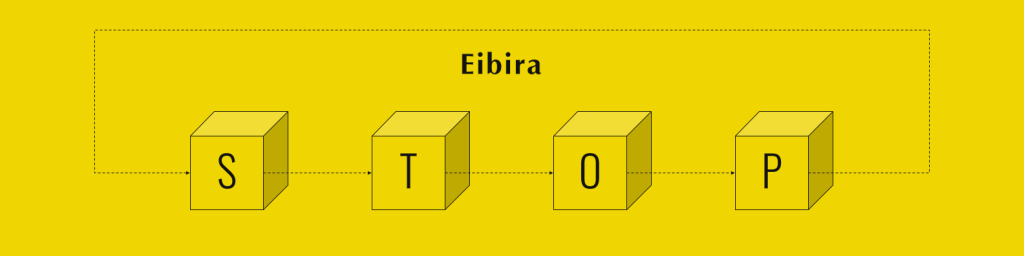
“Eibira exists to make embodied decision-making practical: a repeatable STOP loop that helps you slow down, label what’s happening, choose with intention, and learn from the outcome.”
The second thing that has shaped my thinking is very simple: it’s called Copernican humility; my problems are not very unique, and they don’t form the axis on which the world will make its decisions.
Problems happen because we are human beings. They don’t happen to a chair or a plastic bag.
And anyone can survive problems when they have tools to gain clarity amidst the chaos. Eibira is my attempt to make that clarity repeatable.
Consequential Entrepreneurship
“Solve your own problems before you spend a lot of time finding problems for others.” – Seth Godin
My first start-up was about waking up with an idea and turning it into reality.
My second start-up solves a problem I have an intimate knowledge of.
The STOP Framework, thinking models, and breathing techniques in Eibira aren’t my experiences packaged as features. They’re practical approaches that align how we think with how we actually decide under stress.
So, why does Eibira exist?
My hope is that Eibira becomes a small, repeatable way for you to find clarity regardless of the size of the decision. Especially when life isn’t fair, distraction is the norm, and decisions are really about choosing the regrets you can live with.
Related article:
 Nikhil Kabadi