As a lifelong mindfulness practitioner and someone always looking for ways to improve decision-making, I designed the STOP framework to help everyone make better, more intentional choices.
It is a result of putting together years of personal experience (coming from a lot of really bad decisions so that the really good one’s stood out), research, and deep exploration into the science of decision-making.
Below are some questions on this framework, along with key insights that will help you get started.
List of FAQ’s:
- General Introduction
- Understanding the Framework
- The Science Behind STOP
- Practical Applications
- Overcoming Challenges
General Introduction
What is the STOP framework?
STOP is a mindful productivity framework designed to improve decision-making. It equips you with the skills to make better choices by integrating mindful awareness, emotional clarity, and thoughtful execution.
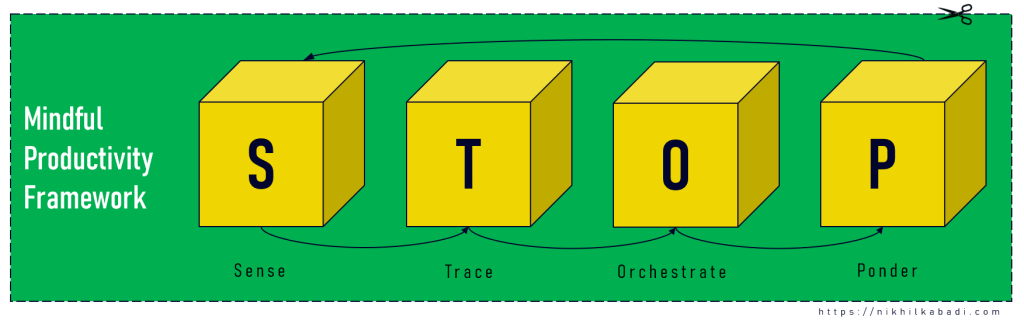
STOP stands for Sense, Trace, Orchestrate, Ponder – four essential steps to align your actions with what truly matters. It serves as a foundational skill upon which all other mindful productivity practices take shape.
If you’re looking for a practical, science-backed way to make better decisions in work and life, STOP is your tool – the best thinking available for you.
Who can benefit from the STOP framework?
Recently, my 10-year-old son was throwing tantrums resisting practicing math. He just wasn’t in the mood. Instead of forcing him, I asked him to take five deep breaths and write down what he was feeling. And this is what he scribbled: “I’m bored annoyed. I feel sleepy.”
Then I asked him the same thing I had been telling him before: “You need to do your work today.” But this time, his response was different: “Okay. How many sums?”
With kids, you never can tell what will work or won’t, but this small shift – acknowledging emotions before acting – highlights an important facet on one’s approach to work.
The STOP framework is for everyone of us who needs to make a decision – big or small, personal or professional. It is not about forcing yourself into action, but rather making choices that you can commit to with clarity and confidence.
Just like an exercise, the more one practices STOP, the better one becomes in making good decisions.
Why is the STOP framework central to Mindful Productivity?
Think of decision-making like fitness training. A well-balanced workout doesn’t focus on just one muscle group – it’s about building strength across all areas.
Similarly, a good decision engages both your emotional and rational mind. However, in a world that celebrates bias for action and is increasingly myopic towards quick decisions, we rarely pause to feel our feelings; ending up acting impulsively. This leads to reactive decisions rather than mindful ones.
STOP creates mental space to evaluate decisions, ensuring they align with your long-term well-being of happiness, longevity, and satisfaction rather than short-term impulses.
Understanding the Framework
What does each step in STOP stand for?
STOP is an acronym for Sense, Trace, Orchestrate, Ponder – a structured way and time-tested principle to make mindful decisions.
1️⃣ Sense: Pause and observe your feelings. What are you feeling before making identifying it with an emotion?
2️⃣ Trace: Put your feelings into words. Emotional granularity helps you to accurately name emotions.
3️⃣ Orchestrate: Act with full presence and intention. Bring your whole self into your work.
4️⃣ Ponder: Reflect on how you feel after the decision. Is this decision helping you grow?
Each step is designed to slow down impulsive decision-making and introduce self-awareness into your choices.
How do I use the STOP framework in my daily life?
The best way to apply STOP is to pick one real decision and run it through these four steps.
Example: Let’s say you’re feeling unmotivated at work.
1️⃣ Sense: What are you feeling? (Pleasant, unpleasant, or neutral? Calm, agitated, or neutral?)
2️⃣ Trace: Label the appropriate emotion concept (“There is frustration,” “There is boredom”).
3️⃣ Orchestrate: Act based on this awareness. Do you need a break? A different approach?
4️⃣ Ponder: Reflect – did your approach make work more meaningful? Are your emotions the same they were earlier?
Over time, STOP becomes second nature.
You can check this example on how I practiced it recently for one of my decisions to gain more insight into this practice.
Do I need to follow the steps in a specific order?
Yes. The order is intentional.
First, you sense feelings, then trace them as emotions, before taking orchestrated action, and finally pondering the results. This ensures that decisions are made mindfully, not reactively.
With practice, these steps will blend naturally into your decision-making process. Mindful thinking becomes second-nature and automatic.
The Science Behind STOP
What is the science behind STOP?
STOP is an applied philosophy rooted in these three sciences:
🔹Psychology: Decision-making is a learned skill. STOP integrates behavioral psychology, emotional intelligence, and cognitive biases to help you make more conscious choices.
🔹Mindfulness: Presence improves decision quality. STOP uses your breath as an anchor to apply mindfulness techniques like non-dual awareness and Vipassana principles leading to clarity.
🔹Evolutionary Biology: Your brain makes feelings and emotions are your learned experiences influenced by your genetic make-up and culture. STOP aligns decision-making with how your brain is wired, helping you manage instinctive emotional responses.
By combining these three sciences, STOP is a practical tool, not a feel-good concept.
How does the framework help us make better decisions?
Human evolution has made feelings (affect) the foundation of decision-making – long before rational thought came into play. Whether we realize it or not, our brain constantly interprets internal body states to construct emotions, which in turn influence our choices.
The STOP framework helps you work with this natural process rather than against it. Instead of reacting impulsively based on pre-labeled emotions, STOP trains you to first sense raw feelings (affect) before assigning meaning to them. This prevents misinterpretation, allowing for more accurate emotional understanding and deliberate decision-making.
By slowing down and separating feeling from emotional labeling, you gain clarity on what your body is signaling and how best to respond.
“Ignoring feelings in decision-making is like ignoring a GPS signal – you might still reach your destination, but you’ll take unnecessary detours and wrong turns along the way.”
In today’s world of instant gratification, emotional overwhelm, and constant busyness, decisions driven by misinterpreted emotions can lead to chronic stress, poor habits, and unproductive cycles. STOP teaches you to pause, interpret emotions accurately, and respond with intention – helping you make decisions that align with both logic and well-being.
Practical Applications
Can STOP help me handle stress and uncertainty?
Most of us think decisions are about choosing an action. But every decision is actually about choosing a regret you’re willing to live with.
Do you regret working long hours but having no time for health? Or do you regret prioritizing health but progressing slower in your career? The choice is always there.
STOP helps you make intentional decisions where you own the consequences instead of being a victim of them.
Mindful Productivity isn’t about avoiding regret; it’s about choosing the right regret.
Stress and uncertainty have been part of humanity since the day neocortex took shape. The difference between then and now being the stressors and uncertainties we choose to live with. Mindful Productivity isn’t about avoiding stress; it’s about choosing the right stress.
How does STOP improve work productivity and decision-making?
Productivity isn’t about doing more – it’s about doing the right things.
If your smartwatch tells you that you had 8 hours of sleep but you wake up feeling exhausted, the data is useless. Similarly, if you check off all tasks in a sprint but feel unfulfilled, you’re not truly productive.
As George Mack in the Modern Wisdom podcast rightly summarizes this dichotomy of busyness masquerading as productivity:
“The busy trap is the idea that we are busy today because we were busy yesterday and we will be busy tomorrow because we are busy today and it is this never-ending busyness that we get busier because we are busy now!”
STOP ensures that your work is aligned with your well-being, preventing mindless busyness and promoting meaningful progress.
Can the STOP framework help me find meaningful work?
Yes, the STOP framework is designed to help you find meaningful work. It teaches you to interpret emotional patterns and equips you with the right tools to align work with your long-term goals.
Your feelings shift over time – what excites you today may feel unfulfilling tomorrow. This isn’t random; your brain constantly constructs emotions based on context, experience, and internal body states.
Instead of chasing fleeting motivation, STOP trains you to sense how work truly feels in your body (affect) before assigning meaning to it (emotion). By regularly reflecting (Ponder step), you can recognize patterns in how certain types of work impact your energy, motivation, and well-being.
But awareness alone isn’t enough – this is where the Orchestrate step becomes critical. STOP doesn’t just help you interpret emotions; it provides a toolkit of skills to help you reshape your work, develop new abilities, and refine your approach to better align with your evolving aspirations.
“Finding meaningful work isn’t about a single perfect job – it’s about aligning your work with what consistently brings you engagement, joy, and growth over time”.
What are the key areas where the STOP framework can be applied?
The STOP framework is a versatile decision-making tool that applies in these six key areas of life and work:
1️⃣ Mindful Agency (internal foundation): Developing self-awareness, embracing new perspectives, and navigating emotional landscapes with confidence and resilience.
2️⃣ Mindful Time-Management (intentional daily actions): Aligning actions with values, prioritizing what truly matters, and using time intentionally rather than reactively.
3️⃣ Mindful Intelligence (balancing rational and emotional minds): Using your wise mind, fostering creativity, and embracing slow productivity to focus on quality over quantity.
4️⃣ Mindful Relationships (Building meaningful connections): Practicing active listening, presence, and authentic communication while overcoming self-doubt, inferiority, or superiority complexes.
5️⃣ Mindful Adaptability (Resilience and growth): Embracing change, uncertainty, and shifting priorities with awareness rather than resistance.
6️⃣ Mindful Leadership (Scaling mindfulness to influence and culture) → Making compassionate and ethical decisions, fostering a work culture based on values, emotional intelligence, and long-term thinking.
Each of these areas represents a practical application of STOP – helping individuals and organizations move beyond reactive decision-making to intentional, purpose-driven, and empathetic approach to actions.
Overcoming Challenges
What if I struggle to sense or label my emotions?
For many of us, pausing to sense feelings and label emotions will feel unnatural at first. We’re often conditioned to push through discomfort rather than acknowledging it.
The key is to start small. Take just a few moments to observe your breath and sense underlying feelings before you label them as emotions. You don’t need to name them immediately – simply recognizing their presence is the first step.
You can begin this practice right now:
1️⃣ Sit still and take three slow, deep breaths.
2️⃣ Ask yourself,
- “Am I feeling pleasant, unpleasant, or neutral?” (Valence)
- “Am I feeling calm, energized/agitated, or neutral?” (Arousal)
3️⃣ As feelings emerge, simply note them. Say to yourself: “I’m feeling pleasant and calm” or “I’m feeling neutral”.
4️⃣ Only once you have identified your feelings, move on to labeling them with emotions.
With practice, you’ll sharpen your ability to sense feelings and trace emotions, making it easier to process them before they unconsciously dictate your actions.
Related topic: Enhance your emotional granularity
How do I find time for reflection (Ponder) in a busy schedule?
Many people struggle with finding time to reflect because they associate productivity with constant action. But as Shane Parrish wisely puts it in his blog:
“The difference between good and exceptional isn’t hours worked – it’s the depth of thought applied to the right problems”.
Pondering your decisions and actions is worth spending those few minutes to gather the courage to step off the hamster wheel and step in to the elevator of mindful growth and progress.
What are some simple ways to get started with STOP?
The easiest way to start is by practicing Step 1: Sense.
Right now, take just five minutes to pause and notice what you’re feeling. Try this short exercise:
The key is experiencing STOP in action rather than overanalyzing it. Start small, practice when you’re making everyday decisions, and over time, it will become second nature.
🍪Fortune Cookie:
STOP is not just a decision-making tool – it’s a lifestyle choice to live more intentionally. By engaging both your emotional and rational mind, you are choosing your well-being, prioritizing your long-term goals, and pursuing meaningful work.
For more decision-making techniques on mindful productivity, connect with me on LinkedIn.
 Nikhil Kabadi